
Backgammon takes minutes to learn and a lifetime to master. This short guide gets you through your first game. When you want more, our full Beginner's Guide to Backgammon has worked examples, a glossary and answers to common questions.
The goal
You and your opponent each have 15 checkers. You move them around the board in opposite directions, bring all of them into your home board, then remove them, which is called bearing off. The first player to bear off all 15 checkers wins.
The board
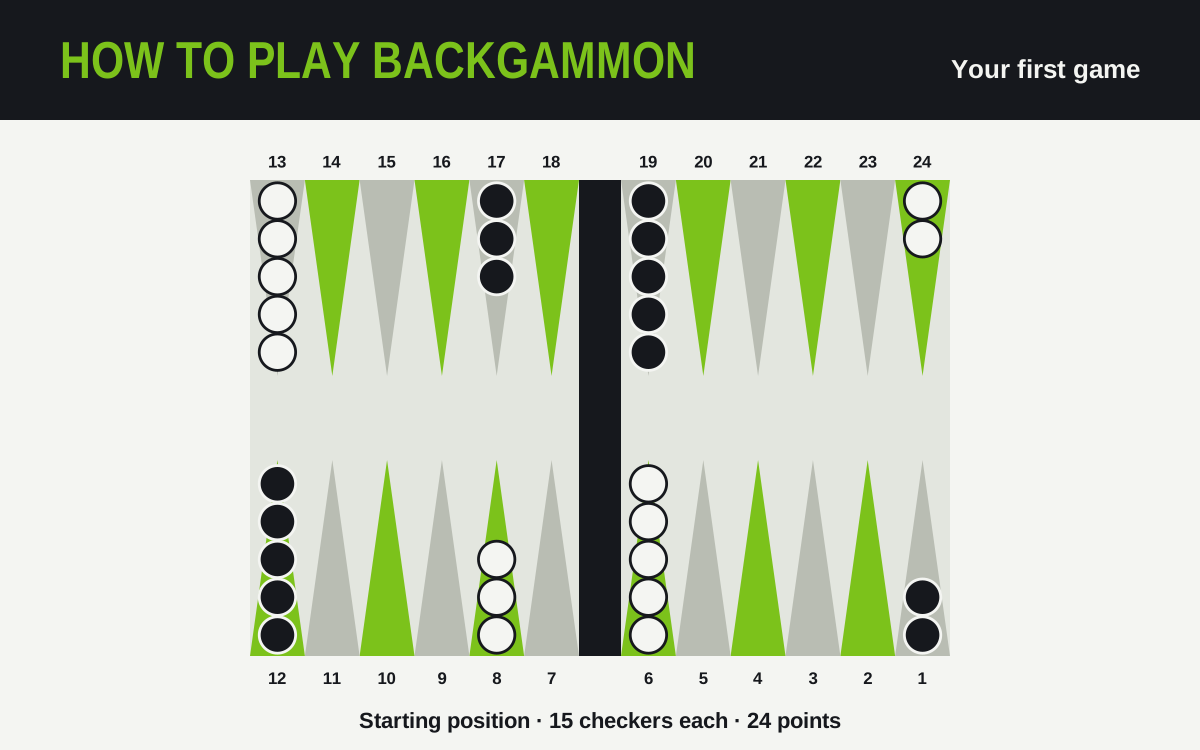
The board has 24 narrow triangles called points, in four quarters of six. Your home board is the six points you're heading towards. A raised strip in the middle, the bar, divides the board in half. The diagram shows the standard starting position from White's side: two checkers on the 24-point, five on the 13-point, three on the 8-point and five on the 6-point. Black's checkers mirror them.
Moving with the dice
- Roll two dice. Each die is a separate move: a 5 and a 2 means one checker moves 5 points and one moves 2, or a single checker moves 5 and then 2.
- You must use both dice if there's any legal way to do it. If you can only play one of them, you must play the higher number when that's possible.
- Roll a double and you move that number four times. Double 3s means four moves of 3.
- You can land on any point that's empty, holds your own checkers, or holds just one of your opponent's.
- A point with two or more of your opponent's checkers is blocked. You can't land there.
Hitting and the bar
A single checker on its own is called a blot, and it's vulnerable. Land on an opponent's blot and you hit it: it goes to the bar in the middle of the board. A player with a checker on the bar must bring it back in before moving anything else. It enters on the opponent's home board on the point matching one of the dice, as long as that point isn't blocked. If neither number can enter, the turn is lost.
That's why two checkers together, a made point, are so valuable: they're safe from being hit and they block your opponent.
Bearing off
Once all 15 of your checkers are in your home board, you can start bearing off. Roll a 4 and you can remove a checker from the 4-point. If there's no checker on that point, you must move a checker from a higher point if you can. If there are no checkers on higher points, you can bear off from the highest point that has one. If one of your checkers is hit while you're bearing off, it has to travel all the way back home before you can continue.
How a game is scored
| Result | What happened | Worth |
|---|---|---|
| Single game | The loser has borne off at least one checker | 1 point |
| Gammon | The loser hasn't borne off any checkers, but has none left on the bar or in the winner's home board | 2 points |
| Backgammon | The loser hasn't borne off any and still has a checker on the bar or in the winner's home board | 3 points |
Once you're comfortable, learn the doubling cube next. It lets a player offer to double the stakes during a game, and the opponent either accepts or gives up the game. It's what makes backgammon matches so tactical, but you don't need it for your very first game.
Your first-game checklist
- Set up the 2–5–3–5 starting position, with your opponent mirroring you.
- Each player rolls one die; the higher number goes first, using both dice from that roll. If the dice tie, both players roll again.
- Move in your direction, using each die as a separate move.
- Use both dice if you legally can, or the higher one if only one can be played.
- Play doubles four times.
- Bring any checker on the bar back in before making other moves.
- Get all 15 checkers home, then start bearing off.
- Count the result: single, gammon or backgammon.
Where to play next
The best way to learn is to sit down across from someone. If you're in Las Vegas, the Backgammon Social Club's Stackgammon 7 night at Dream Kabob on Thursday, October 29 is a sociable place to start. Its chip stacks, rising chip awards and $1-per-chip cashout are that event's own format, so expect different scoring from the standard game described here.