
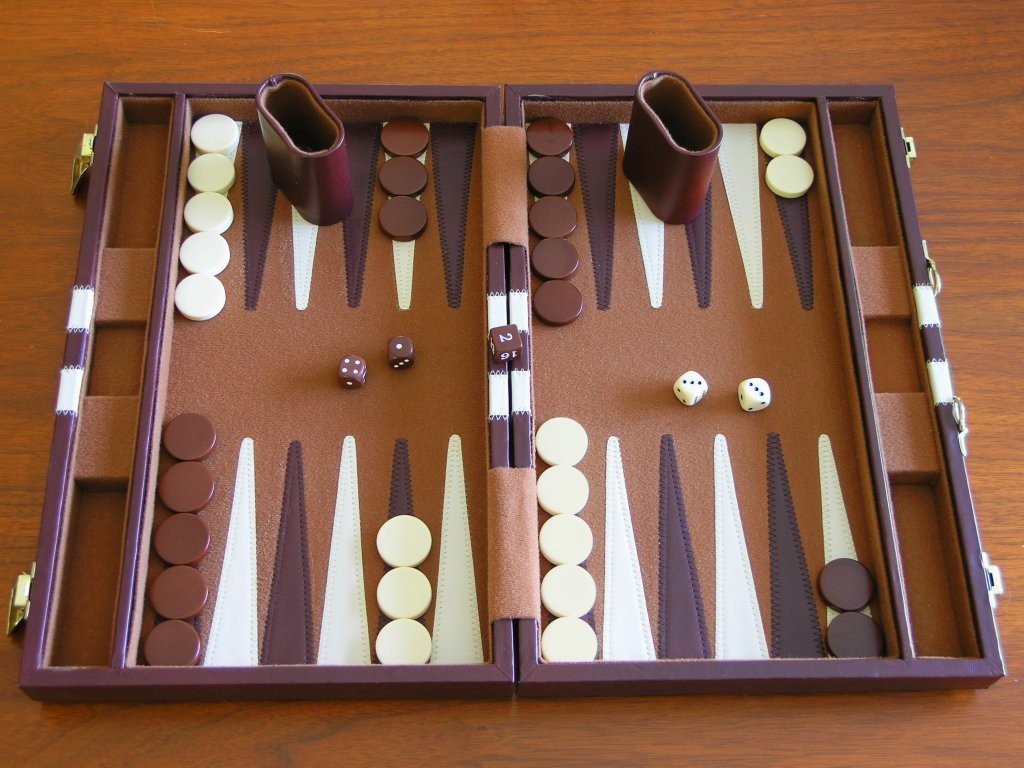
Backgammon is a race with contact. Two players move fifteen checkers each using dice, trying to bring them home and remove them first. You can block points or hit exposed checkers along the way. Learn the setup and compulsory-move rules first; strategy becomes easier once every move has a clear reason.
Keep the Beginner’s Guide to Backgammon beside your board, explore Learn to Play and check the Rules whenever a position raises a question.
How is a backgammon board laid out?
The board has 24 narrow triangles called points, traditionally alternating in colour. Their colours help you count; they do not assign ownership. Four quadrants contain six points each. The central ridge is the bar, where hit checkers wait. Each player has a home board, also called an inner board, and an outer board. Your home board contains your points 1–6, the last six points before your checkers leave the board.
Number from your own home board: your 1-point is nearest the bear-off edge, and your 24-point is farthest away along your route. The opponent’s numbering runs the other way. Your 1-point is their 24-point; paired numbers total 25. Boards may be oriented differently at the table, so agree the home boards rather than memorising “always go left.”
What is the standard starting position?
| Your point | Your starting checkers |
|---|---|
| 24 | 2 |
| 13 | 5 |
| 8 | 3 |
| 6 | 5 |
That is two on 24, five on 13, three on 8 and five on 6: fifteen in total. Your opponent sets up the same pattern from their own perspective. On your numbered board their stacks therefore sit on 1, 12, 17 and 19. The starting position is mirrored, not two identical colours placed on the same four points.
Follow the arrows and numbers in our board-setup lesson. Both players move towards their own lower-numbered points, travelling in opposite directions around the board.
Who rolls first, and how do the dice move checkers?
Each player rolls one die. Ties are rerolled. The higher roller starts using those two numbers—not a fresh roll. If you roll 5 and your opponent rolls 2, you begin with a 5–2. After that opening turn, players alternate rolling two dice. A 5–2 means one five-point move and one two-point move, in either order.
You can move two different checkers or use both numbers on one checker. Each number is a separate move with its own landing. In the opening position, 13/8 and 24/22 uses 5–2 to bring one checker down five points and split a back checker two points. Another legal option is 13/8 and 13/11. The slash notation means “from/to,” not division.
What makes a move legal?
A destination is open if it is empty, occupied by your own checkers or occupied by exactly one opposing checker. Two or more opposing checkers block it. You may pass over a blocked point within a single die move, but cannot land there. To move one checker using both dice, at least one order must give a legal intermediate landing as well as a legal final landing.
Use both dice whenever a legal sequence allows it. You cannot choose an attractive one-die play if another sequence uses both. If only one number can be played, play it. If either number can be played but not both together, you must use the higher. Rolling doubles gives four moves of that number: 3–3 means four three-point moves. Use as many as legally possible; unused moves do not carry over.
How do hitting and bar entry work?
One opposing checker alone is a blot. Landing on it hits it: put it on the bar and occupy its point. A player with any checker on the bar must re-enter all barred checkers before moving others. Entry goes into the opponent’s home board. A die of 1 enters on your 24-point, 2 on your 23-point, continuing to 6 on your 19-point.
Entry destinations follow the same blocking rule. With one checker barred and 3–2, you could enter on your 22-point using the 3, then use the 2 legally elsewhere once the bar is clear. If both entry points are blocked and no entry is possible, your turn ends. A six-point closed home board keeps you out until a point opens.
When can I bear off?
Bearing off removes checkers from play. It begins only when all fifteen of your remaining checkers are in your home board. An exact number removes a checker from that point: a 4 can bear off from point 4. You may instead make a legal move within the home board if the dice-use rules permit it.
If the rolled number is above your highest occupied point, remove a checker from that highest point. With checkers only on 4, 2 and 1, a 6 may remove one from 4. But if you still have a checker on 6, a 5 cannot remove one from 4; you must use the 5 legally, such as 6/1. If you are hit during bearing off, re-enter and bring the checker home before resuming removal.
What are a gammon, backgammon and doubling cube?
First to bear off all fifteen wins. If the loser has removed at least one checker, it is a single win. If they have removed none, it is a gammon, worth twice the cube value—unless they also have a checker on the bar or in the winner’s home board, making it a backgammon worth three times the cube. Gammon and backgammon are alternative results, never added together.
The doubling cube is not rolled. Before rolling on your turn, you may offer to double the game value when cube ownership and match rules allow it. A take accepts the new value and gives the taker cube ownership; a pass loses the game at the value before the offer. The first offer changes 1 to 2. In matches, Crawford forbids doubling for the single game immediately after a player first reaches one point from the target.
Start without the cube if you prefer, then read the doubling-cube lesson. Before organised play, consult our tournament-rules summary for clocks, dice and director procedures.
Which beginner tactics help most?
- Build points with two checkers: connected points restrict the opponent’s routes.
- Try to free your back checkers before the opponent builds a strong home board.
- Weigh a hit against the blot it leaves; an opponent’s stronger board makes return hits more dangerous.
- Spread useful builders rather than stacking every spare checker on one point.
- Count the race when contact ends. Once the players have passed, contact cannot be recreated.
For your first game, count aloud, identify each die’s landing and check the bar before touching another checker. Ask what a move achieves, not merely whether it feels safe. A bad roll is not proof of a bad decision; review the options you had when you played.
Beginner questions answered
- How many checkers does each player start with?
- Fifteen. From your own perspective place two on point 24, five on point 13, three on point 8 and five on point 6. Your opponent uses the mirrored layout.
- Can I choose not to use a die?
- No. You must use both dice if legally possible. If only one can be used, play it; if either can be used but not both, use the higher number. With doubles, use as many of the four moves as possible.
- Can I move backwards or jump over blocked points?
- You cannot move backwards. You may pass over blocked points within a single die move, but each die’s destination must be open. Combining both dice requires a legal intermediate landing.
- Do I need a doubling cube for my first game?
- No. You can learn checker movement with the cube unused and each game worth one point. Introduce the cube and match-scoring rules once both players are comfortable with legal moves.
Your next move
Miami Open runs November 17–23. Visit its Masters / Super Jackpot, ABT Open Main and WWB Women’s Cup pages for each contest’s current deadline and availability. These are separate from paid tournament registration.
Next on the US calendar is the California State Championship, December 2–6. California fantasy entry is coming soon; tournament registration uses the organiser’s official form. Check Fantasy for live open contests. Fantasy is free play for adults 18+, using virtual points only, with no current prizes.
Free-play fantasy · virtual points only
Build a lineup for an open contest
Fantasy lineup entry is separate from official tournament registration.
Checking open fantasy contests…
Learn the game. Follow the players. Play the fantasy. Learn to Play · Rules · Fantasy