Backgammon has an ancient family history, but not a single, securely documented birthday. Boards, dice, texts and paintings show people playing race games across the Near East and Mediterranean long before the modern name existed. They do not show an unchanged rulebook handed down for five thousand years. The more interesting story is one of invention, adaptation and communities making a familiar board their own.
Did backgammon begin in ancient Mesopotamia?
Mesopotamia provides remarkable evidence for early race games. The British Museum’s Royal Game of Ur board dates to 2600–2400 BCE and has twenty decorated squares, not the 24 points of a modern backgammon board. A much later Babylonian tablet, dated 177 BCE, helps explain a version of the game. These finds show how deeply rooted dice-driven racing is, not that Ur is a proven direct ancestor of backgammon.
That distinction matters. A race track, pieces and a random throw are shared design ideas, but similar equipment does not establish identical rules or an unbroken genealogy. Ancient Egyptian senet belongs in the broader discussion of early board games too; it should not simply be renamed backgammon. Claims that the modern game is “the world’s oldest” usually compress several different histories into one easy slogan.
Archaeological scholarship also complicates the usual straight line from Ur to Rome. Encyclopaedia Iranica’s survey discusses early Iranian boards with rows of twelve fields divided into groups of six. Their resemblance to tables boards is significant, but their exact rules remain unknown. An object can establish a design feature without proving that its owner played today’s hitting, doubles or bearing-off rules.
What did the Romans play?
Roman ludus duodecim scriptorum—usually translated as the game of twelve markings—used a board with three rows of twelve spaces. Later Roman and Byzantine evidence includes tabula, associated with the two-row, 24-point form. These are much closer relatives of the tables-game tradition than a generic ancient race game, although reconstruction still depends on fragmentary evidence.
A famous poem by Agathias describes an unfortunate position and roll involving the emperor Zeno, who ruled in the fifth century CE. It gives historians an unusually concrete glimpse of tabula. Reconstructed versions use fifteen pieces each and three dice. That third die alone is a warning against treating a Roman game as modern backgammon with an old-fashioned name. A recognizable board can host a different game.
For an accessible reconstruction, see Tabula at Backgammon Galore. Reconstruction is an interpretation of historical evidence, not an original Roman instruction sheet.
Why is Persian nard central to the story?
Persia is central both to the early evidence and to the game’s cultural memory. Nard, with names such as nardshir in historical discussion, appears in Middle Persian literary traditions. Stories connect its invention with Sasanian rulers or with the wise court figure Bozorgmehr and a contest of ingenuity involving chess. These narratives tell us how people understood the game’s prestige; they are not a contemporary patent record.
Iranica notes competing traditional dates, including associations with the third and sixth centuries CE, and stresses that the history remains poorly understood. We can acknowledge Persia’s important role without assigning a definitive invention year or choosing a legend as fact. Trade, courts, migration and multilingual communities provided channels for games to travel, but the route of any particular rule often cannot be reconstructed.
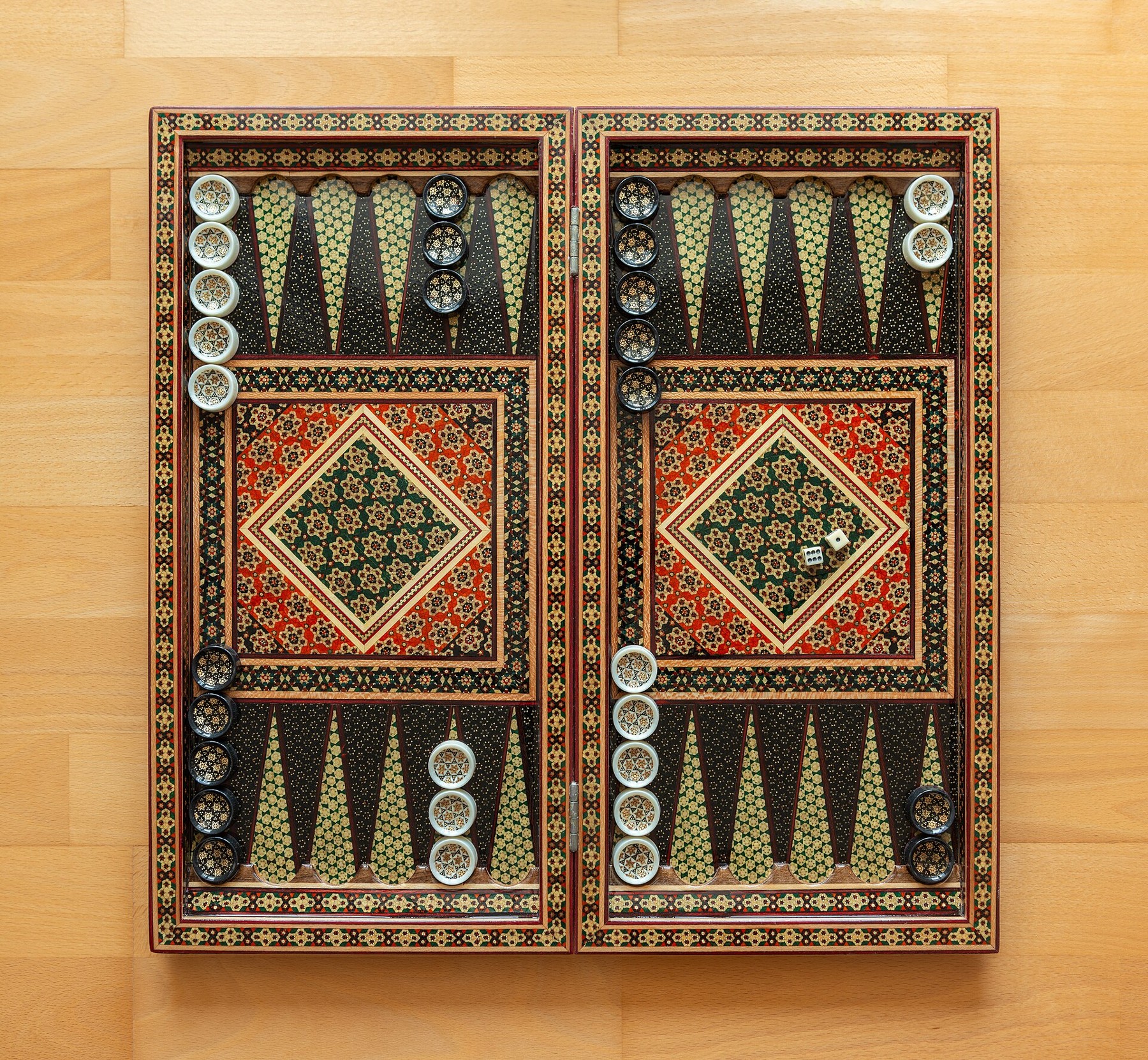
Today takhteh nard, or takhteh, names a living Iranian board-game tradition. The board itself may be a beautifully made object: khatam marquetry uses intricate geometric inlay, as in the modern photograph accompanying this story. Such craftsmanship demonstrates continuing cultural attachment. It does not make a photographed modern board an ancient artifact, nor imply that every local session uses international tournament conventions.
How did medieval tables become English backgammon?
In medieval Europe, “tables” described a family of games played on the familiar divided board. Manuscripts, literary references and surviving objects show the equipment crossing languages and social settings. Alfonso X’s thirteenth-century Spanish Libro de los juegos records tables games alongside chess and other games. Historical Spanish names such as tablas reales belong to that landscape; they should not be read as proof of one standardized modern rule set.
England also had several tables games, including Irish, an important predecessor in accounts of backgammon’s development. The English name backgammon appears in seventeenth-century evidence. Exact “first use” dates vary between popular histories, so the defensible summary is mid-seventeenth century rather than an overconfident single year. “Back” and “game” are commonly proposed roots, fitting the return journey imposed on a hit checker, but the name’s origin is not completely settled.
Printed rules and instructional books gradually made specific forms easier to transmit. Edmond Hoyle’s eighteenth-century writing belongs to this later culture of codifying play. Even then, the existence of a rulebook did not erase household customs. Backgammon’s standardization was a process, not the moment every tables player in Europe agreed to play the same way.
What is backgammon called around the world?
Names carry geography, but also rule differences. Ask how a game starts, whether singles are hit or pinned, which direction the pieces travel and whether the cube is used before assuming that a familiar board means familiar play. Spellings below are common English transliterations; local scripts and pronunciation vary.
| Name / setting | What to know |
|---|---|
| Tavla · Türkiye | Traditional and modern backgammon play; a cube should not be assumed in a casual traditional game. |
| Tavli · Greece | Umbrella for Portes, Plakoto and Fevga, not simply three interchangeable spellings of backgammon. |
| Takhteh nard · Iran | Persian naming and play traditions; check the agreed local rules. |
| Nard / nardy · Russia, Caucasus, Central Asia | A family of names; short and long forms must be distinguished. |
| Shesh besh · Israel | A widely used name, commonly explained through six and five; house rules may differ. |
| Tawla · Arabic-speaking communities | Regional names and conventions vary; no single Arabic ruleset is implied. |
| Trictrac · historical France | A distinct tables game with its own scoring, not a synonym for every modern French game. |
| Tablas reales · historical Spain | A historical tables-game name; context and recorded rules matter. |
| Backgammon · Anglophone / international play | Usually the standard contrary-movement game, with match and cube conventions specified separately. |
Greek tavli often cycles through Portes, Plakoto and Fevga. Portes is closest to standard backgammon; Plakoto pins a lone opposing checker instead of sending it to the bar; Fevga is a same-direction blocking race. Traditional tavli does not use a doubling cube. Calling all three “Greek backgammon” is convenient, but hides the decisions that make each game different.
Likewise, long nardy / Narde is a same-direction race without hitting, unlike short nardy’s backgammon-style contact. The labels nard and nardy also travel across the Caucasus and Central Asia; the spoken name alone is not a complete rules specification. Turkish tavla and Greek tavli are related linguistic and cultural neighbours, not a reason to flatten their variants.
South Asian gaming traditions deserve the same care. Historical Persian–Indian exchanges appear in literary accounts, and local tables-style play exists, but games such as pachisi and chaupar use different boards and mechanisms. They are not simply regional backgammon. Recognizing shared habits—racing, chance and social competition—need not erase the distinct games or claim a single documented transmission route.
When did the cube and modern tournaments arrive?
The doubling cube is a twentieth-century innovation associated with American play in the 1920s. It transformed the decision space: winning chances, gammon risk and the price of accepting an offer became part of the contest. It was not carried on ancient boards, and it remains absent from many traditional variants. Its spread is a clear example of backgammon changing rather than standing still.
Organised tournaments, match scoring and published strategy developed further during the twentieth-century boom, including the international prominence of Monte Carlo. More recently, analysis software, online play, clocks and recorded matches have given players new ways to study decisions. These tools can standardize competition while local clubs continue to preserve social rhythms and regional forms. History is still being made whenever a new player joins the table.
A short, evidence-aware timeline
| Period | Evidence or development |
|---|---|
| 2600–2400 BCE | Ur boards document a twenty-square race game; direct backgammon ancestry is unproven. |
| Ancient Iran | Boards share tables-like structural features; precise rules are uncertain. |
| Roman / Byzantine era | Duodecim scriptorum and tabula provide closer tables-family evidence. |
| Sasanian literary tradition | Nard gains prominent origin narratives; dates of invention remain uncertain. |
| Medieval Europe | Many tables games circulate, including those in Alfonso X’s compilation. |
| 17th–18th centuries | English backgammon emerges in records; printed instruction expands. |
| 1920s onward | American doubling-cube play, later tournament growth and digital analysis. |
Keep the Beginner’s Guide to Backgammon beside your board, explore Learn to Play and check the Rules whenever a position raises a question.
History questions answered
- Is backgammon really 5,000 years old?
- Ancient race games are thousands of years old, and early boards share features with the tables-game family. That does not establish that today’s backgammon rules existed 5,000 years ago or that the Royal Game of Ur was its direct ancestor.
- Who invented backgammon?
- No single inventor is securely established. Archaeology, Roman and Persian traditions, medieval tables games and later English rules describe a long development rather than one documented invention.
- Are tavla, tavli and nardy the same game?
- Not automatically. Turkish tavla includes traditional and modern play; Greek tavli is an umbrella for Portes, Plakoto and Fevga. Short nardy resembles backgammon, while long nardy is a same-direction, no-hitting game.
- When did the doubling cube become part of backgammon?
- It developed in American play in the 1920s. It is a modern addition, not an ancient component, and many regional tables games still do not use it.
Your next move
Miami Open runs November 17–23. Visit its Masters / Super Jackpot, ABT Open Main and WWB Women’s Cup pages for each contest’s current deadline and availability. These are separate from paid tournament registration.
Next on the US calendar is the California State Championship, December 2–6. California fantasy entry is coming soon; tournament registration uses the organiser’s official form. Check Fantasy for live open contests. Fantasy is free play for adults 18+, using virtual points only, with no current prizes.
Free-play fantasy · virtual points only
Build a lineup for an open contest
Fantasy lineup entry is separate from official tournament registration.
Checking open fantasy contests…
Learn the game. Follow the players. Play the fantasy. Learn to Play · Rules · Fantasy